
What the Navy does day to day
Most of the Navy's work is simply being there, far from home. By the Congressional Research Service's reckoning, up to 30 percent of the fleet can be deployed overseas at any one time, including two or three carrier strike groups and two or three amphibious ready groups. Most of that presence sits in the Western Pacific, the Indian Ocean and Persian Gulf, and European waters.
The Navy also carries the sea leg of the nuclear deterrent. Its ballistic missile submarines are dedicated to strategic deterrence, and CRS notes they're understood to be the only Navy ships carrying nuclear weapons. The service withdrew its nonstrategic naval nuclear weapons in 1991.
Ships and sailors
The authorized active-duty Navy for fiscal 2026 was 344,600 sailors, and next year's budget request seeks 356,600. The Navy's 2026 budget submission also counted 57,500 reservists and 201,119 civilian employees.
Ship counts depend on who's counting and when. The usual yardstick is battle force ships. A CRS shipbuilding report from January 2026 put the fleet at 293 on Oct. 1, 2025, while a CRS primer published weeks earlier gave 290 for the same date. Either way, the total has stayed between 270 and 300 since 2003.
The goal keeps moving. A 2016 target of 355 ships was made official policy by the fiscal 2018 defense authorization act, though nothing enforces it. A 2023 assessment called for 381 crewed ships plus 134 large unmanned vessels, and a new "Golden Fleet" goal still hadn't been released in mid-January 2026. Federal law does set floors: at least 11 operational aircraft carriers and at least 31 operational amphibious warfare ships, 10 of them big-deck assault ships.
How the fleet is organized
The Navy shares the Department of the Navy with the Marine Corps. One civilian secretary runs both services, and both top officers, the Chief of Naval Operations and the Marine Commandant, are Joint Chiefs members. Budget documents labeled "Navy" cover the Marines too.
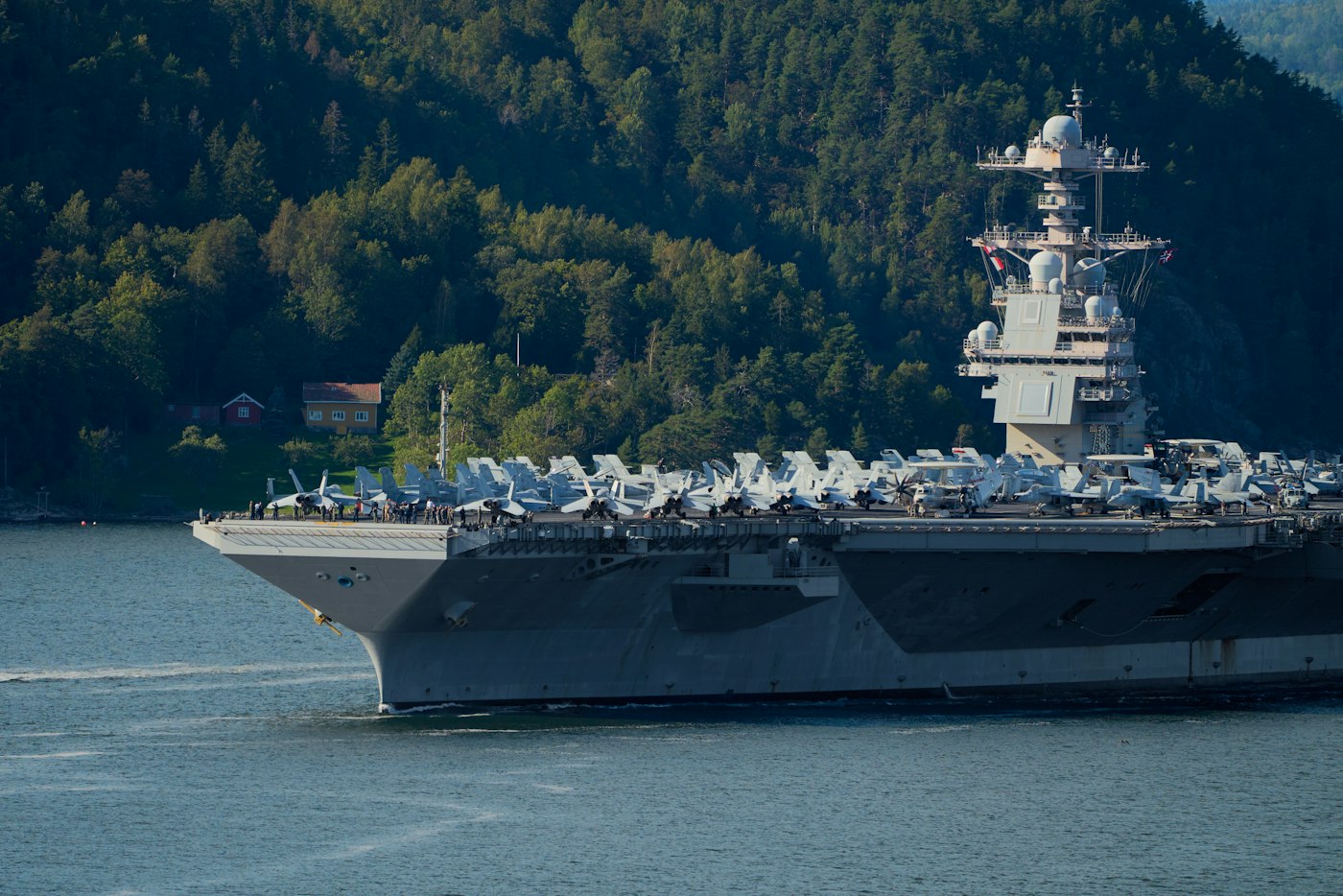
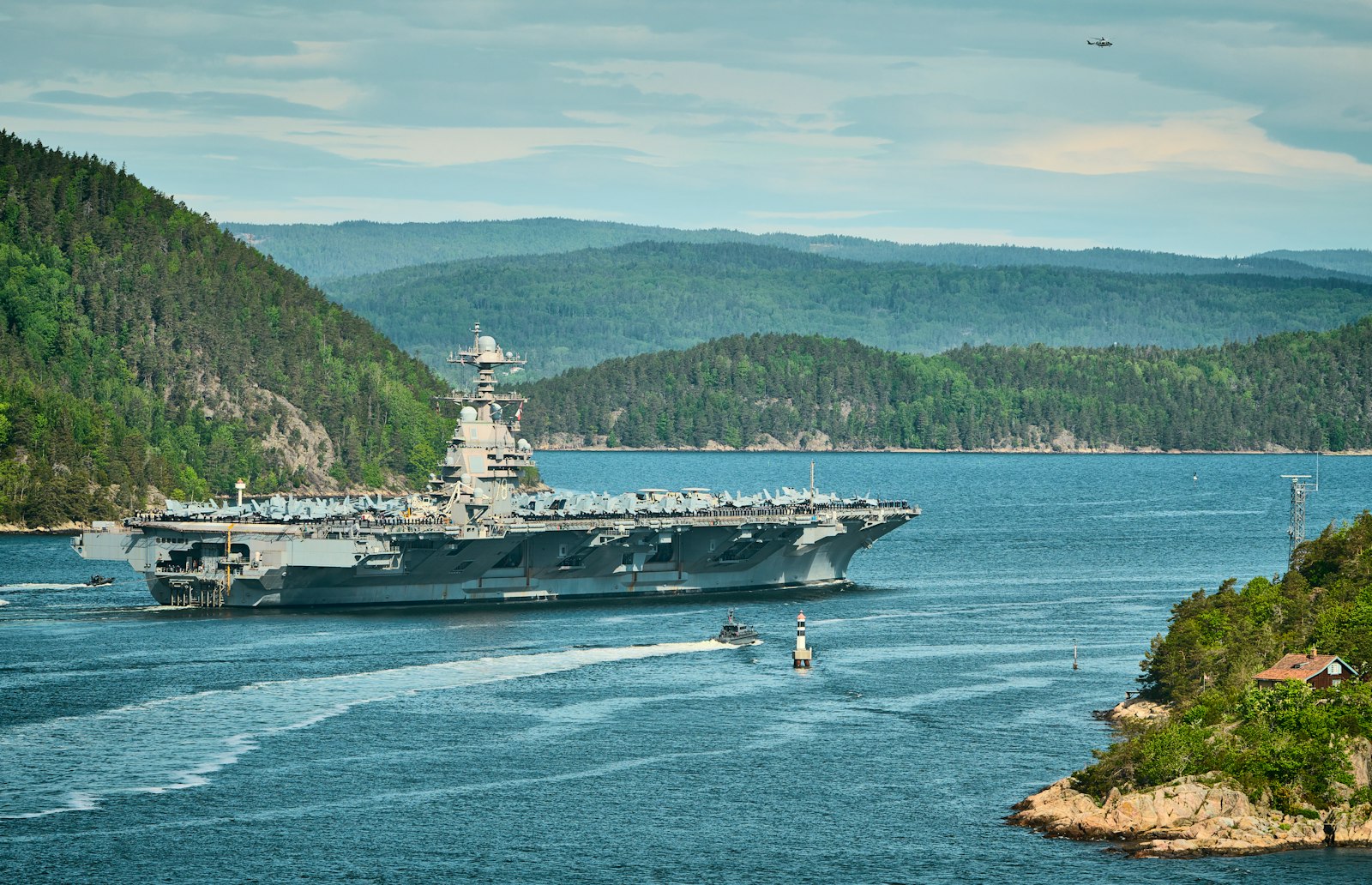
At sea, ships work in groups. A carrier strike group typically pairs a carrier and its air wing with three to five cruisers and destroyers, a combat logistics ship and sometimes an attack submarine. An amphibious ready group pairs a big-deck amphibious assault ship with two smaller amphibs, and together they carry a Marine expeditionary unit, typically upward of 2,000 Marines. Surface action groups are cruisers and destroyers sailing without a carrier.
Next guide: Nimitz vs. Ford
What changed between the Navy's two classes of nuclear-powered supercarriers.
Main bases
Naval Station Norfolk, on Sewell's Point in Virginia, is a major base for the Atlantic Fleet. Naval Technology lists more than 75 ships homeported there, from carriers and destroyers to submarines and supply ships, along with about 14 piers, 134 aircraft and roughly 3,100 ship movements a year. The Navy bought the land in 1917.
Overseas, Japan is the Navy's largest forward homeport. CRS says it hosts a carrier strike group, an amphibious ready group and mine warfare ships. The Navy also keeps ships based in Bahrain, Spain and Italy.
Ships, subs and aircraft
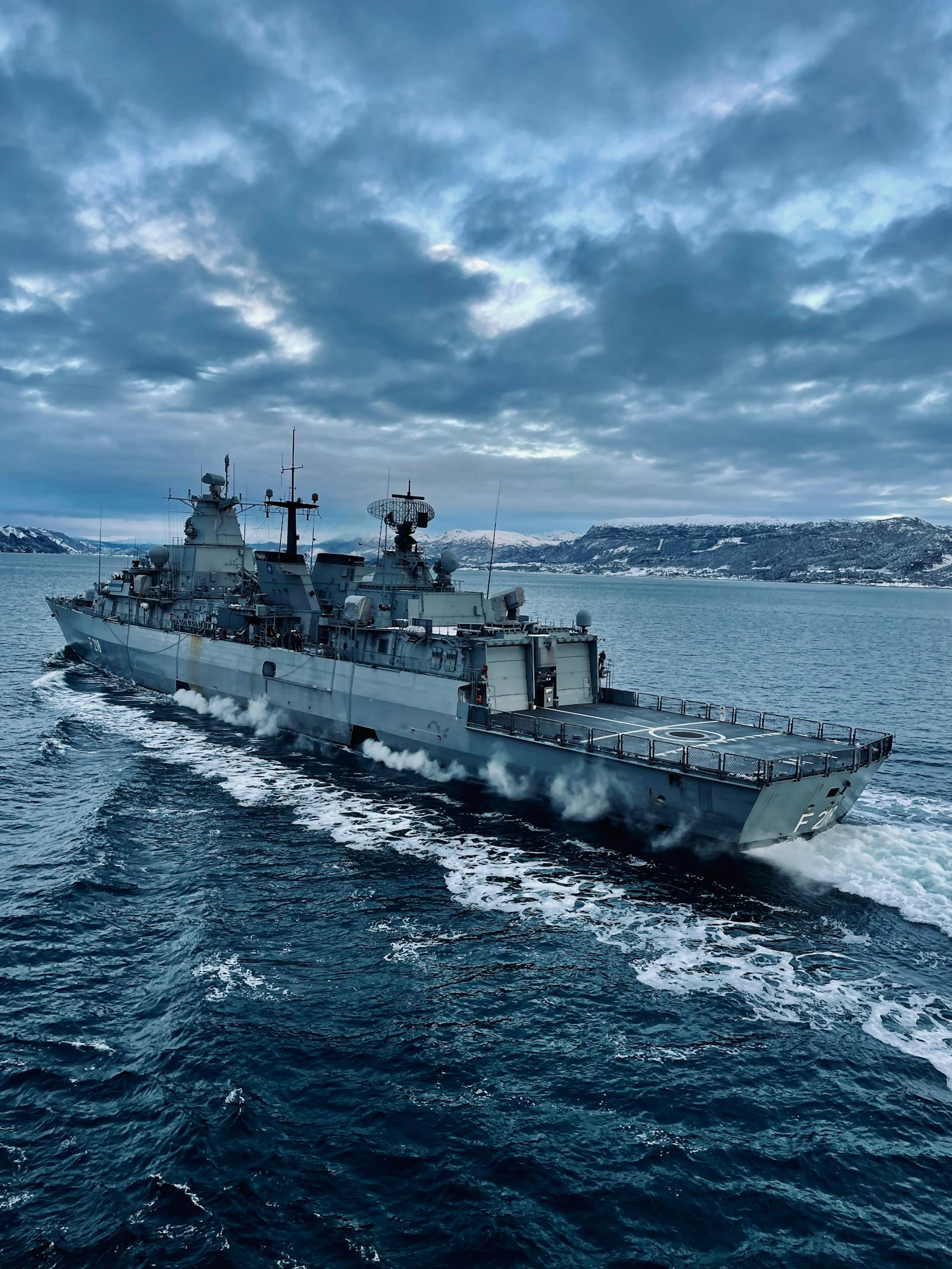
Every carrier and submarine in the fleet is nuclear powered, with two reactors in a carrier and one in a submarine. All other Navy ships are conventionally powered. Ballistic missile submarines handle deterrence, while attack submarines take on a mix of missions. Cruisers and destroyers make up the large surface combatants. Frigates, Littoral Combat Ships, mine warfare ships and patrol craft are the small ones. A carrier air wing has more than 60 aircraft, 40 or more of them strike fighters.
Joining the Navy
Every enlisted sailor starts at Recruit Training Command in Great Lakes, Illinois, which the Navy calls its only enlisted training facility. Boot camp now lasts nine weeks. It grew from eight to 10 weeks in 2022, when the Navy added a two-week "Sailor for Life" curriculum, then dropped back to nine for recruits arriving on or after Jan. 6, 2025. Recruits have to pass a swim test, and the course builds to Battle Stations, a 12-hour test set in shipboard scenarios. Officers don't go to Great Lakes. They go through Officer Candidate School or Officer Development School instead.
Our basic training guide compares Great Lakes with the other services, and the Navy SEALs guide covers the special warfare pipeline.
Navy coverage on this site
Past the basics, our Navy articles look at how the fleet fights and where it has fought. Read about the Aegis Ashore site in Romania, the difference between a cruiser group and a carrier strike group, and the Battle of Midway from our history section.
Sources
- Congressional Research Service: Navy Force Structure and Shipbuilding Plans (RL32665)
- Congressional Research Service: Defense Primer: Naval Forces (IF10486)
- Congressional Research Service: Defense Primer: Department of the Navy (IF10484)
- Congressional Research Service: FY2027 NDAA: Active Component End-Strength (IN12728)
- Naval Technology: Naval Station Norfolk
- Navy.com: Boot camp
- Task & Purpose: Navy cuts boot camp length